The coins of 20th-century Italy reflect a nation shaped by significant political, economic, and cultural transformations. From establishing the Kingdom of Italy to its transition into a republic and eventual adoption of the euro, Italy’s coinage serves as a tangible record of these historical developments. This blog provides a chronological overview of Italian coins during the 20th century, covering key periods such as Pre-World War I, Post-World War I, the rise of Mussolini, Post-World War II, and the decades leading up to Italy’s transition to the euro.
Pre-World War I Italy Coins (1861–1914)
Italy became a unified kingdom 1861 under Victor Emmanuel II, and the coinage system was standardized as part of the Latin Monetary Union (LMU). Coins minted during this period adhered to the LMU standards, with denominations in lire and centesimo.
- Coins were struck in denominations of 1, 2, 5, 10, 20, 50 centesimi, and 1, 2, 5, 10, 20 lire.
- Precious metal coins included:
- Gold: 20 lire, 50 lire, and 100 lire.
- Silver: 1 lira, 2 lire, 5 lire.
Designs and Denominations
- Obverse: Featured portraits of monarchs such as Victor Emmanuel II and later Umberto I.
- Reverse: Typically displayed the coat of arms of the Kingdom of Italy, surrounded by wreaths or inscriptions.
- 20 Lire Gold Coin: A popular LMU denomination containing 0.1867 troy ounces of gold.
- 5 Lire Silver Coin: A larger coin used for significant transactions, struck until silver was removed from general circulation in the early 20th century.
Coins from this era were widely circulated until World War I disrupted the Italian economy, leading to inflation and a reduction in precious metal content.
Post-World War I Italy Coins (1918–1922)
The aftermath of World War I brought economic hardship to Italy, with inflation eroding the value of the lira. The monetary system required adjustments to address these challenges.
- Coins of smaller denominations were minted in nickel, aluminum, and bronze to replace the more expensive silver and gold coins.
- Higher denominations were issued as banknotes to conserve metal resources.

Designs and Denominations
- Traditional themes persisted, including portraits of Italian monarchs such as Victor Emmanuel III and depictions of national symbols like the eagle.
- 10 Centesimi (1919–1922): Struck in nickel, featuring the traditional fasces (a bundle of rods symbolizing power and unity).
- 50 Centesimi (1920): An aluminum coin with reduced weight, reflecting post-war metal shortages.
Coins from this period illustrate Italy’s struggle to stabilize its economy in the face of post-war inflation and political unrest.
Rise of Mussolini and Fascist Italy (1922–1945)
Benito Mussolini’s rise to power in 1922 ushered in the era of Fascist Italy. Coinage during this period reflected the regime’s emphasis on nationalism and propaganda.
- The lira remained the standard currency, with denominations ranging from 5 centesimi to 20 lire.
- Coinage often incorporated fascist symbols, including the fasces, an ancient Roman symbol adopted by Mussolini’s regime.
Designs and Denominations
- Obverse: Continued to feature portraits of Victor Emmanuel III.
- Reverse: Fascist motifs, such as fasces and eagles, became dominant.
- 5 Lire (1927): Struck in silver, depicting an eagle clutching a fasces on the reverse.
- 50 Centesimi (1936): A nickel coin featuring Mussolini’s slogan “Vincere” (to win).
- 20 Lire Gold Coin (1923–1930): Minted in small quantities, these coins retained the LMU standard and featured traditional royal imagery.
The Fascist period emphasized symbols of strength and unity, reflecting Mussolini’s political ideology. However, World War II severely disrupted Italy’s economy, leading to a decline in coin production.
Post-World War II Italy Coins (1946–1970s)
Following the defeat of Fascism in 1945, Italy became a republic in 1946. The country introduced new coinage to reflect its democratic identity.
- The lira was retained as the currency, with a revised system of denominations in centesimi and lire.
- Due to post-war economic constraints, coins were made from base metals, including aluminum, stainless steel, and bronze.
Designs and Denominations
- Themes emphasized peace, productivity, and Italy’s rich cultural heritage.
- Obverse: Featured allegorical figures such as Italia Turrita symbolizing the nation.
- Reverse: Included agricultural motifs like wheat ears and olive branches, representing prosperity.
- 10 Lire (1946–1950): A small aluminum coin featuring a plow, symbolizing agriculture.
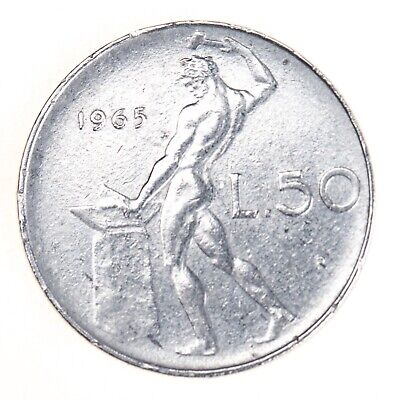
- 50 Lire (1954): Made of stainless steel, depicting Vulcan, the Roman god of fire and metalworking.
- 100 Lire (1955): Introduced as a larger stainless steel coin featuring a female figure embodying Italia.
Post-war coins marked a departure from the propagandist themes of the Fascist era, focusing instead on national recovery and economic growth.
Italy Coins from the 1970s
The 1970s were a period of modernization for Italian coinage, with new designs and materials introduced to meet changing economic demands.
- Higher denominations, such as 500 lire, were introduced to accommodate inflation.
- Coins continued to be struck in base metals like stainless steel and aluminum-bronze.
- 500 Lire (1970): A bimetallic coin featuring a sailing ship, symbolizing exploration and trade. It was one of the world’s first modern bimetallic coins.
- 50 Lire (1975): Redesigned with a smaller diameter to reduce production costs.
Coins from the 1970s reflected Italy’s efforts to modernize its currency while maintaining its cultural identity.
Italy Coins from the 1980s and 1990s
By the 1980s, inflation had significantly reduced the purchasing power of the lira, necessitating the introduction of higher denominations.
- Coins of 100 lire, 200 lire, and 500 lire became standard in daily transactions.
- The bimetallic 500-lire coin gained popularity due to its innovative design and practicality.
Designs and Denominations
- Historical Figures: Many coins featured prominent Italian figures, such as artists, scientists, and explorers.
- Commemorative Issues: Special coins were minted to celebrate events such as the Olympic Games and anniversaries of Italian unification.
- 100 Lire (1981): Featuring a new depiction of Italia Turrita with updated design elements.
- 200 Lire (1980): Struck in aluminum-bronze, featuring a gear and cogwheel design symbolizing industry.
- 500 Lire (1990): Bimetallic coin with a sailing ship design representing Italy’s maritime history.
These coins highlighted Italy’s cultural and historical achievements, offering collectors various designs.
Transition to the Euro (1999–2002)
Italy adopted the euro as its official currency on January 1, 1999, and introduced physical coins and banknotes in 2002. The transition marked the end of the lira’s long history.
Euro Coins
Italian euro coins feature designs that celebrate the country’s artistic and cultural heritage:
- 1 Euro Cent: Depicts the Castel del Monte, a 13th-century castle in Apulia.
- 10 Euro Cents: Features a portion of Botticelli’s painting, The Birth of Venus.
- 1 Euro: Shows Leonardo da Vinci’s Vitruvian Man, symbolizing art and science.
The euro coins reflect Italy’s integration into the European Union while preserving elements of its national identity.
Conclusion
The coins of 20th-century Italy provide a fascinating window into the country’s history, from its unification and monarchy to its evolution as a republic and member of the European Union. Each era’s coinage reflects the political and economic realities of the time, offering collectors a diverse range of designs and materials to explore. Whether focused on pre-war silver coins, Fascist-era issues, or modern bimetallic designs, Italian coins tell the story of a nation navigating the complexities of the 20th century.