The Washington Quarter, introduced in 1932 to commemorate the 200th anniversary of George Washington’s birth, is a staple of U.S. coinage history. Designed by John Flanagan, it features Washington’s portrait on the obverse and an eagle on the reverse. The 1964 Washington Quarter, made of 90% silver, holds particular value for collectors and investors, as its silver content and historical significance contribute to its worth beyond face value. This coin remains a key piece in U.S. numismatics and a popular choice for those interested in silver coinage.
1964 Quarter Design
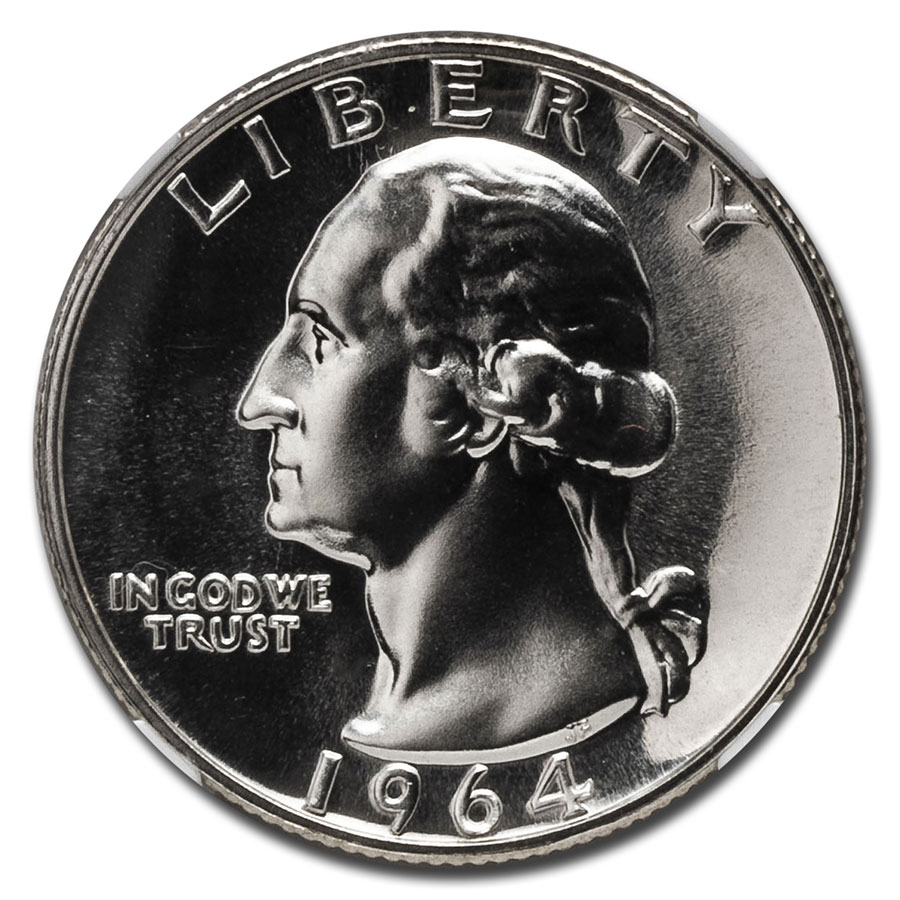
The coin features John Flanagan’s familiar design, with a portrait of George Washington on the obverse and an eagle on the reverse. This design has been used since 1932 to commemorate Washington’s 200th birthday.
1964 Washington Quarter Dollar Coin Composition
1964 quarters are made of 90% silver and 10% copper, with a total silver weight of 0.18084 troy ounces. This makes them valuable not only as collectible coins but also for their silver content, significantly when silver prices rise.
After 1964, the U.S. Mint switched to using a copper-nickel-clad composition for quarters due to the rising cost of silver. The 1964 quarters mark the end of the Silver Quarter era.
Although the 1964 quarter is technically the last silver quarter, some 1965 quarters were struck using silver planchets leftover from 1964, making 1965 silver quarters a rare and valuable error coin to look out for.
1964 Washington Quarter Mintage
1964 quarters were minted in large quantities for circulation.
Over 564 million were produced at the Philadelphia Mint (no mint mark) and around 704 million at the Denver Mint (marked with a small “D” on the reverse).
In 1964, Washington Quarters were minted in three locations, with the following mintage figures:
- Philadelphia Mint: 564,341,347
- Denver Mint: 704,135,528
- San Francisco Mint: None for circulation, but the San Francisco Mint produced proof coins for collectors.
1964 Washington Quarter Proof
The 1964 Silver Proof Quarter was a special issue produced by the San Francisco Mint for collectors. These proof coins have a higher level of detail and a mirror-like finish.
- Proof Mintage: Approximately 3,950,762 proof quarters were minted in 1964.
1964 Quarter Values
While circulated 1964 quarters are generally worth their silver melt value, uncirculated or higher-grade coins, especially those certified by grading companies like PCGS or NGC, can be worth significantly more to collectors.
Coin Condition
The value of 1964 quarters can vary greatly depending on their condition. Mint State (MS) quarters can fetch premium prices, with some achieving values upwards of $25 or more in high grades, especially those with Full Torch Bands (FTB) details or exceptional eye appeal.
Certified 1964 Quarters
Certified 1964 quarters are coins graded and authenticated by professional third-party grading services like PCGS (Professional Coin Grading Service) or NGC (Numismatic Guaranty Corporation). These coins are encapsulated in tamper-proof holders and are assigned a numerical grade based on their condition.

- Certified coins carry a premium over raw coins due to their verified condition and authenticity.
How to Identify if a 1964 Quarter is Silver
To determine if a 1964 Washington Quarter is silver:
- Date: All quarters from 1964 and earlier are 90% silver.
- Edge: Silver quarters have a solid silver-colored edge, whereas copper-nickel-clad quarters (from 1965 onward) have a copper-colored line along the edge.
- Sound: Silver coins produce a distinct, high-pitched ring when dropped, whereas clad coins sound duller. This is often referred to as the “ping test.”
Collector Value of a 1964 Quarter
The value of a 1964 Washington Quarter depends on several factors:
- Silver Content: As of today, the silver melt value for a 1964 quarter (90% silver, 0.18084 troy ounces of silver) fluctuates with the market price of silver.
- Condition: Quarters in circulated condition are worth slightly above melt value, while those in uncirculated or Mint State (MS) grades can be worth more. Quarters with sharp details and minimal wear are highly sought after.
- Rarity: Certain varieties, like those with errors (double die, repunched mint marks), are more valuable.
Proof Washington quarters struck in 1964 are highly collectible, especially those with a cameo or deep cameo finishes.
These proof coins, struck for collectors, were minted in San Francisco, and feature superior strike and finish quality. In general, collectors seek out coins in high-grade condition, particularly MS65 or higher condition, that are graded by PCGS or NGC.
The price difference between an MS63 coin and an MS67 coin can be significant due to the rarity of well-preserved examples.
1964 Washington Quarter Varieties and Error Coins
1964-D Quarter Doubled Die Obverse
- Another popular coin is the 1964-D doubled die error. Like the 1963-D, it doubles on the obverse, particularly in the motto and date. This error can be pretty valuable, especially in uncirculated conditions.
1964 Quarter Transitional Error
- As the U.S. Mint transitioned from silver to clad coinage in 1965, there have been reports of transitional errors, where 1964-dated quarters were accidentally struck on copper-nickel clad planchets for 1965 quarters. These rare errors are highly valuable to collectors.
1964-D Repunched Mint Mark (RPM)
- This is a variety in which the “D” mintmark was punched more than once, resulting in a visible doubling of the mintmark.
- RPM varieties are popular with collectors, and the doubling can vary, adding intrigue and value.
More Popular Quarter Error Coins from the 1960s
1961-D Washington Quarter (Repunched Mint Mark – RPM)
- This error features a punched “D” mintmark. These error coins can significantly increase in value, especially in higher conditions. RPM varieties are always popular with error collectors.
1963-D Washington Quarter (Doubled Die Obverse)
- This error involves doubling some of the lettering on the obverse, particularly noticeable in the words “IN GOD WE TRUST.” Doubled die errors are highly sought after due to their rarity.