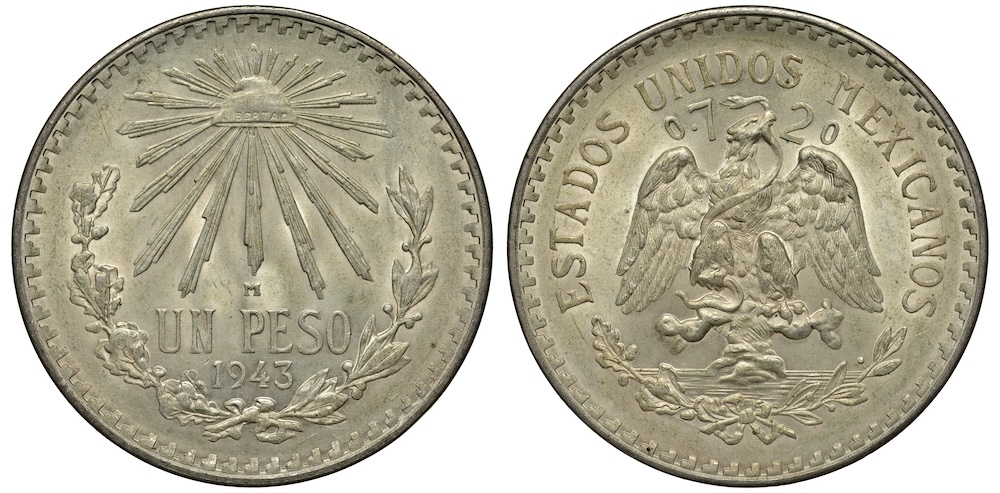
Mexico has one of the richest silver coinage traditions in the world. The mines of Zacatecas, Guanajuato, and Taxco made New Spain the largest silver producer on earth for over two centuries — and that silver ended up in coins that circulated from China to colonial America to Europe. Today, Mexican silver coins range from colonial Pieces of Eight struck in the 1700s to modern Libertad bullion coins still being minted.
This guide covers every silver denomination in Mexican coinage history: silver content, fineness, weight specs, and how to calculate melt value at any spot price.
Jump to the live calculator: Mexican Silver Coin Melt Value Calculator →
Melt values update automatically with the live silver spot price.
Which Mexican Coins Are Silver?
The short answer: Mexican circulation coins dated 1945 and earlier are almost always silver. After 1945, silver content declined sharply and was phased out entirely by the late 1960s for most denominations. Post-1970 coins are base metal — with the exception of the Onza (1949–1980) and Silver Libertad (1982–present), which are bullion coins, not circulation issues.
| Era | Silver Content | What to Look For |
|---|---|---|
| Colonial (pre-1821) | .903–.917 fine | 8 Reales “Pillar Dollar,” “Bust Dollar” |
| 1905–1914 | .800 fine | Centavos and Pesos, eagle design |
| 1918–1919 | .800 fine | Transitional reduced-weight issues |
| 1919–1945 | .720 fine | Cap & Sunrays Pesos, centavos |
| 1947–1949 | .500 fine | Morelos 1 Peso |
| 1950–1951 | .300 fine | Low-silver Morelos Peso, 50 centavos |
| 1950–1953 | .300 fine | 25 centavos |
| 1957–1967 | .100 fine | Aztec Calendar Peso — very low silver |
| 1968–1972 | .720 fine | Olympic 25 Pesos (commemorative) |
| 1977–1979 | .720 fine | 100 Pesos |
| 1949–1980 | .925 fine | Onza (bullion) |
| 1982–present | .999 fine | Silver Libertad (bullion) |
Post-1968 circulating Pesos are not silver. The base-metal 1 Peso with the Aztec Calendar design (1970 onward) and virtually all coins after the 1979 currency reform contain no silver.
Colonial Era: The 8 Reales (Piece of Eight)
Mexico City’s Casa de Moneda, established in 1535, is the oldest mint in the Americas. For nearly three centuries it struck the coin that would become the world’s first global currency: the 8 Reales.
The Pillar Dollar (1732–1772) — KM#104
The “Pillar Dollar” design — two crowned globes flanked by the Pillars of Hercules with the motto PLUS ULTRA — is one of the most recognizable coin designs in history. Struck at .917 fine silver with a gross weight of 27.07 grams, each Pillar Dollar contains 0.7985 oz of actual silver weight (ASW).
These coins circulated as legal tender in the United States until 1857. They were the standard trade coin of the Pacific — Spanish galleons carried them from Acapulco to Manila, where they were melted into Chinese silver ingots or recirculated across Asia.
Key date: The 1732 first-year issue commands a significant premium. All dates are collectible; Mexican issues are the most commonly available of all Pillar Dollars.
Melt value at current spot: approximately the value of 0.7985 oz of silver — but numismatic value on all Pillar Dollars substantially exceeds melt. Do not melt these.
The Bust / Eagle Dollar (1772–1821) — KM#106
The later colonial 8 Reales replaced the Pillars with a portrait bust of the reigning Spanish king. Same silver content (.903 fine, 27.07 g, 0.7859 oz ASW). This design was used through Mexican independence in 1821.
Post-Independence Silver (1905–1967)
After independence, Mexico continued striking silver coins through the early 20th century. The modern silver series that most collectors encounter today begins with the Porfirian-era issues of 1905.
The Porfirian Era: 1905–1914 (.800 Fine)
Under President Porfirio Díaz, Mexico reformed its coinage in 1905 to the international silver standard, striking centavos and Pesos in .800 fine silver.
| Denomination | Years | Fineness | Gross Weight | ASW (oz t) |
|---|---|---|---|---|
| 10 Centavos | 1905–1914 | .800 | 2.5 g | .0643 |
| 20 Centavos | 1905–1914 | .800 | 5.0 g | .1286 |
| 50 Centavos | 1905–1918 | .800 | 12.5 g | .3215 |
| 1 Peso (Caballito) | 1910–1914 | .903 | 27.07 g | .7859 |
The Caballito Peso (KM#453) deserves special mention. Designed by sculptor Emilio del Moral, it depicts Liberty riding a horse in full gallop — “caballito” means “little horse.” With only 907,748 struck across a handful of years, it is widely regarded as one of the most beautiful coins ever produced by any mint in the world. Its numismatic value far exceeds its melt value of ~0.7859 oz silver. If you find one, have it graded before selling.
Transitional Issues: 1918–1919 (.800 Fine, Reduced Weight)
World War I silver pressures prompted Mexico to reduce coin weights while keeping .800 fineness. These transitional issues are short-lived and slightly scarcer than the main series.
| Denomination | Years | Fineness | ASW (oz t) |
|---|---|---|---|
| 10 Centavos | 1919 | .800 | .0466 |
| 20 Centavos | 1919 | .800 | .0926 |
| 50 Centavos | 1918–1919 | .800 | .2330 |
| 1 Peso | 1918–1919 | .800 | .4663 |
Cap and Sunrays Era: 1919–1945 (.720 Fine)
The most common Mexican junk silver era. Fineness dropped to .720 and the reverse design changed to a Liberty cap with sunrays. The Peso in this series ran for 25 years and is widely available in circulated grades — the workhorse of Mexican silver stacking.
| Denomination | Years | Fineness | Gross Weight | ASW (oz t) |
|---|---|---|---|---|
| 10 Centavos | 1925–1935 | .720 | 1.66 g | .0384 |
| 20 Centavos | 1920–1943 | .720 | 3.33 g | .0771 |
| 50 Centavos | 1919–1945 | .720 | 8.33 g | .1928 |
| 1 Peso | 1920–1945 | .720 | 16.6 g | .3843 |
These are the coins most likely to turn up in junk silver lots. The 50 Centavos and 1 Peso from this era represent good silver value and are easy to find.
Declining Silver: 1947–1967
After World War II, silver content dropped steeply. Mexico went from .720 to .500, then .300, and finally .100 fine on the 1 Peso — essentially eliminating silver from everyday coinage.
| Denomination | Years | Fineness | ASW (oz t) | Notes |
|---|---|---|---|---|
| 50 Centavos | 1935 | .420 | .1076 | Short transitional issue |
| 50 Centavos | 1950–1951 | .300 | .0642 | Low silver |
| 25 Centavos | 1950–1953 | .300 | .0321 | Low silver |
| 1 Peso (Morelos .500) | 1947–1949 | .500 | .2251 | Jose Maria Morelos portrait |
| 1 Peso (Morelos .300) | 1950 | .300 | .1286 | Low silver |
| 1 Peso (Aztec Calendar) | 1957–1967 | .100 | .0514 | Minimal silver |
The Aztec Calendar Peso (1957–1967) technically contains silver but so little (.100 fine) that at most spot prices the melt value barely justifies sorting it from base-metal coins. For practical purposes, treat the 1970+ base-metal Aztec Calendar coins as no silver.
Key Collector Coins
2 Pesos 1921 — Independence Centennial (KM#462)
Struck to commemorate the centennial of Mexican independence, this .900 fine coin weighs 26.67 grams and contains 0.7717 oz ASW — nearly as much silver as the old Caballito Peso at a fraction of the price. It’s a one-year type with a Liberty head reverse. Easy to find, very popular with silver stackers.
5 Pesos 1947–1948 — Cuauhtemoc (KM#465)
One of the most popular Mexican silver stacking coins. At .900 fine and 30 grams, it contains 0.8681 oz ASW — almost a full troy ounce of silver. The obverse features Cuauhtemoc, the last Aztec emperor. Both 1947 and 1948 dates are commonly available in XF-AU. At any meaningful silver price, these carry good intrinsic value.
| Denomination | Years | Fineness | Gross Weight | ASW (oz t) |
|---|---|---|---|---|
| 2 Pesos | 1921 | .900 | 26.67 g | .7717 |
| 5 Pesos | 1947–1948 | .900 | 30.0 g | .8681 |
| 5 Pesos | 1950–1954 | .720 | 27.78 g | .6431 |
| 5 Pesos | 1955–1959 | .720 | 18.06 g | .4181 |
| 10 Pesos | 1955–1960 | .900 | 28.89 g | .8360 |
The 10 Pesos Hidalgo (KM#474, 1955–1960) is often overlooked — it contains 0.836 oz ASW at .900 fine and can frequently be found near melt. A strong buy-on-the-dip coin.
25 Pesos 1968 — Mexico City Olympics (KM#479.1)
The 1968 Summer Olympics commemorative is one of Mexico’s most recognizable modern silver coins. Struck in .720 fine silver at 22.5 grams, it contains 0.5208 oz ASW. Widely available, frequently traded. It makes an attractive gift or starting point for new collectors.
100 Pesos 1977–1979 (KM#479.2)
An often-overlooked large silver coin. At .720 fine and 27.77 grams, it contains 0.6428 oz ASW — more silver than the Olympics 25 Pesos. These are common and trade near melt, making them an efficient way to accumulate Mexican silver by weight.
Modern Bullion: The Onza and the Libertad
Classic Onza 1949–1980 (KM#494.1)
The Onza (“ounce”) was Mexico’s silver bullion coin before the Libertad era. Struck in .925 fine silver at 33.63 grams, it contains 1.0001 oz ASW — a full troy ounce. The reverse depicts a woman with a balance scale (Balanza). These trade as bullion but have growing collector interest among Mexican coin enthusiasts. Early dates are slightly scarcer.
Silver Libertad 1982–Present (KM#494.2)
Mexico’s premier silver investment coin. The Libertad is struck in .999 fine silver with exactly 1.000 oz ASW. The obverse shows the Mexican coat of arms; the reverse features the Winged Victory (Angel of Independence) from Mexico City’s Monument to Independence.
Annual issues since 1982 in 1 oz size, with fractional sizes (1/20 oz to 2 oz) available. Early dates (1982–1985) have lower mintages and carry a premium over melt in MS grades. Recent years trade close to spot + dealer premium.
Complete Denomination Reference
All Mexican silver denominations in one table — fineness, weight, and actual silver weight (ASW). To get the current melt value, multiply the ASW column by today’s silver spot price, or use the live calculator linked below.
| Denomination | Years | Fineness | Gross Weight | ASW (oz t) |
|---|---|---|---|---|
| 8 Reales (Pillar Dollar) | 1732–1772 | .917 | 27.07 g | .7985 |
| 8 Reales (Bust Dollar) | 1772–1821 | .903 | 27.07 g | .7859 |
| 10 Centavos | 1905–1914 | .800 | 2.5 g | .0643 |
| 10 Centavos | 1919 | .800 | 1.81 g | .0466 |
| 10 Centavos | 1925–1935 | .720 | 1.66 g | .0384 |
| 20 Centavos | 1905–1914 | .800 | 5.0 g | .1286 |
| 20 Centavos | 1919 | .800 | 3.6 g | .0926 |
| 20 Centavos | 1920–1943 | .720 | 3.33 g | .0771 |
| 25 Centavos | 1950–1953 | .300 | 3.33 g | .0321 |
| 50 Centavos | 1905–1918 | .800 | 12.5 g | .3215 |
| 50 Centavos | 1918–1919 | .800 | 9.06 g | .2330 |
| 50 Centavos | 1919–1945 | .720 | 8.33 g | .1928 |
| 50 Centavos | 1935 | .420 | 7.97 g | .1076 |
| 50 Centavos | 1950–1951 | .300 | 6.66 g | .0642 |
| 1 Peso (Caballito) | 1910–1914 | .903 | 27.07 g | .7859 |
| 1 Peso | 1918–1919 | .800 | 18.13 g | .4663 |
| 1 Peso (Cap & Sunrays) | 1920–1945 | .720 | 16.6 g | .3843 |
| 1 Peso (Morelos) | 1947–1949 | .500 | 14.0 g | .2251 |
| 1 Peso (Morelos) | 1950 | .300 | 13.33 g | .1286 |
| 1 Peso (Aztec Calendar) | 1957–1967 | .100 | 16.0 g | .0514 |
| 2 Pesos | 1921 | .900 | 26.67 g | .7717 |
| 5 Pesos (Cuauhtemoc) | 1947–1948 | .900 | 30.0 g | .8681 |
| 5 Pesos (Cuauhtemoc) | 1950–1954 | .720 | 27.78 g | .6431 |
| 5 Pesos (Hidalgo) | 1955–1959 | .720 | 18.06 g | .4181 |
| 10 Pesos (Hidalgo) | 1955–1960 | .900 | 28.89 g | .8360 |
| 25 Pesos (Olympics) | 1968–1972 | .720 | 22.5 g | .5208 |
| 100 Pesos | 1977–1979 | .720 | 27.77 g | .6428 |
| 10 Nuevos Pesos | 1992–1995 | .925 | 5.604 g | .1667 |
| 20 Nuevos Pesos | 1993–1995 | .925 | 8.5 g | .2528 |
| 50 Nuevos Pesos | 1993–1995 | .925 | 17.0 g | .5056 |
| Onza (Classic) | 1949–1980 | .925 | 33.63 g | 1.0001 |
| Silver Libertad | 1982–present | .999 | 31.10 g | 1.0000 |
→ Live melt values with current spot price: Mexico Silver Coin Calculator
How to Calculate Melt Value
Every melt value comes from one formula:
Melt value = ASW (oz t) × silver spot price ($/oz t)
The ASW (Actual Silver Weight) in troy ounces is the only number that matters — it accounts for both the coin’s gross weight and its fineness. The dollar value changes every time spot price moves; the ASW never does.
Example: A 1935 Mexican 1 Peso (Cap & Sunrays, .720 fine) has an ASW of 0.3843 oz t. If silver spot is $32/oz, melt value = 0.3843 × $32 = $12.30. If spot rises to $50/oz, the same coin is worth 0.3843 × $50 = $19.22.
How fineness and weight combine: ASW = gross weight (grams) × fineness ÷ 31.1035 (grams per troy ounce). So the 1935 Peso: 16.6 g × 0.720 ÷ 31.1035 = 0.3843 oz t.
For the current spot price and up-to-date melt values across all 30+ Mexican denominations, use the Mexico Silver Coin Melt Value Calculator — it updates automatically.
How to Identify Mexican Silver Coins
Check the date first. If the coin is dated 1945 or earlier, it almost certainly contains silver (at least .720 fine). If it’s dated 1947–1967, check the specific denomination — fineness dropped significantly during this period.
Look for the denomination. Coins marked “50 Centavos,” “1 Peso,” or “5 Pesos” with dates before 1967 are your primary targets. Post-1967 circulation coins are base metal.
The magnet test. Silver is not magnetic. If a coin sticks to a magnet, it’s definitely not silver. This is a quick screening tool for junk lots.
Weight and size. Silver coins from the .720/.800 era are heavier than modern base-metal coins of the same denomination. A 1938 1 Peso (16.6 g) is noticeably heavier than a later base-metal Peso.
Look at the edge. Most Mexican silver coins have a reeded (ridged) edge. Worn base-metal imitations sometimes show different edge characteristics.
Buying and Selling Mexican Silver
Junk silver lots of .720 fine Mexican Pesos (1920–1945) and 50 Centavos (1919–1945) are common on eBay and at coin shows. These trade close to melt and are a solid way to accumulate silver by weight.
The 5 Pesos Cuauhtemoc (1947–1948) is arguably the best value Mexican silver coin to buy near melt — almost a full troy ounce at .900 fine in a recognizable, attractive design.
The Caballito Peso and 8 Reales should be treated as numismatic coins, not silver by weight. Have them attributed and graded (PCGS or NGC) before selling.
Silver Libertads carry a premium over spot depending on the year. Early dates (1982–1985) in MS65+ can trade at multiples of melt. Recent dates in lower grades trade at small premiums over spot, similar to American Silver Eagles.
Dealers and auction houses that specialize in Mexican coins include Heritage Auctions, Stack’s Bowers, and most large US coin dealers. For generic junk silver, local coin shops and online silver bullion dealers are efficient.
Frequently Asked Questions
Which Mexican coins are silver? Mexican coins dated 1945 and earlier are almost always silver (typically .720 or .800 fine). The main exceptions are the .100 fine Aztec Calendar Peso (1957–1967), which contains very little silver, and the .300 fine coins of 1950–1953. Post-1967 circulation coins contain no silver. The Onza (1949–1980) and Silver Libertad (1982–present) are silver bullion coins.
What is the silver content of a Mexican Peso? It depends on the year and design. A 1920–1945 “Cap and Sunrays” Peso is .720 fine (0.3843 oz ASW). A 1910–1914 “Caballito” Peso is .903 fine (0.7859 oz ASW). A 1947–1949 “Morelos” Peso is .500 fine (0.2251 oz ASW). See the denomination reference table above, or use the live calculator for the current melt value.
Are Mexican 8 Reales worth more than melt? Yes — significantly. All authentic Spanish colonial 8 Reales from Mexico City carry numismatic premiums well above their silver melt value. The Pillar Dollar (1732–1772) and Bust Dollar (1772–1821) are widely collected worldwide. Do not sell these by weight.
What is a Caballito Peso worth? The melt value is approximately 0.7859 × current silver spot price. But the Caballito’s actual market value in circulated grades typically ranges from roughly $150 to $500+ depending on grade and date, with MS examples fetching thousands. It is one of Mexico’s most beloved coins and should always be sold through a numismatic channel rather than as silver scrap.
Is the Mexican Silver Libertad a good investment? The Libertad is a legitimate .999 fine silver bullion coin with 1 oz ASW, similar in purpose to the American Silver Eagle or Canadian Maple Leaf. It trades close to silver spot plus a small premium for recent dates. Early dates in high grades (MS66+) have collector value beyond melt. As a pure silver holding, it’s a straightforward, liquid way to own Mexican silver.
How do I tell if my Mexican coin is silver? Check the date first — 1945 or earlier is the primary indicator for circulation silver. Look up the denomination in the reference table above to confirm the expected ASW and weight. Use a magnet (silver is not magnetic) as a quick screen. For valuable pieces, a reputable coin dealer or calibrated precious metals tester is the most reliable option.
Calculate the current melt value of your Mexican silver coins → Mexico Silver Coin Melt Value Calculator
Updated live with the current silver spot price. All denominations by year, fineness, and ASW.
Related guides: Canadian Silver Coins: Which Years Are Silver · South American Silver Coins · Bolivian Silver Coins Guide