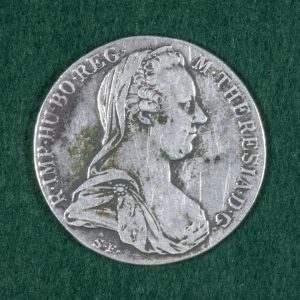
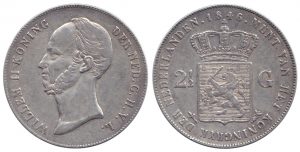
The coinage of the German Empire (Deutsches Kaiserreich) represents a critical chapter in European numismatics. Spanning the years 1871 to 1918, the Empire’s coins reflect Germany’s political unification under Prussian leadership, the adoption of standardized currency, and the economic conditions of a rapidly industrializing nation. This blog explores the gold and silver coins of the German Empire, focusing on their introduction, design, and historical significance.
The Introduction of a Standardized Currency Standard
The unification of Germany in 1871 under Emperor Wilhelm I established a need for a standardized monetary system to replace the diverse currencies the individual German states used. The Coinage Act of 1871 introduced the Goldmark, a currency based on the gold standard. This reform aligned Germany’s monetary system with the international trend toward gold-backed currencies, stabilizing the economy and facilitating trade.
Key Features of the Standardized Currency
- The Goldmark was subdivided into 100 Pfennig.
- Coin denominations were issued in gold, silver, and copper-nickel, reflecting the value hierarchy.
- A unified design theme represented the federal nature of the Empire, with state-specific variations.
The transition to a standardized currency was crucial for consolidating Germany’s economic and political identity during its early years as an empire.
Gold Marks
Gold coins issued during the German Empire were minted in 5 Mark, 10 Mark, and 20 Mark denominations. These coins adhered to the Latin Monetary Union’s 90% gold purity standard, making them valuable in international trade and investments.

Designs
- Obverse: Featured the portrait of the ruling monarch of the issuing state (e.g., Wilhelm I of Prussia, Ludwig II of Bavaria).
- Reverse: Displayed the imperial eagle and the denomination.
Denominations
- 5 Goldmark: The smallest, less commonly minted gold coin often issued for specific states.
- 10 Goldmark: A popular denomination for trade and investment.
- 20 Goldmark: The primary gold coin of the Empire, widely used for savings and more significant transactions.
Key Minting Locations
- Berlin
- Munich
- Stuttgart
- Karlsruhe
- Hamburg
Silver Marks
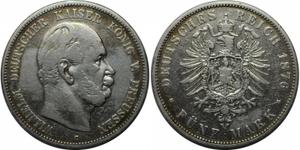
Silver coins were a significant part of the German Empire’s coinage, serving as the backbone of everyday transactions. Denominations included 1/2 Mark, 1 Mark, 2 Mark, 3 Mark, and 5 Mark.
Composition and Specifications
- Made of 90% silver, except for smaller denominations, which were introduced later with reduced silver content.
- Minted in varying sizes and weights proportional to their denomination.
Designs
- Obverse: Typically featured state-specific designs or a common imperial motif.
- Reverse: Showcased the imperial eagle, with the denomination prominently displayed.
Notable Silver Coins
- 5 Mark: Often minted in commemorative editions, such as the 1874 Victory Coin, celebrating the Franco-Prussian War.
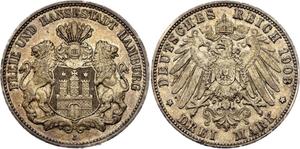
- 3 Mark: Introduced in 1908, it was often issued with exceptional designs to commemorate events like royal anniversaries.
Silver coins of the German Empire are prevalent among collectors for their historical significance and artistic designs.
Copper-Nickel Coins
To accommodate small transactions, the German Empire minted coins in copper-nickel alloys. These coins, issued in denominations of 1 Pfennig, 2 Pfennig, 5 Pfennig, and 10 Pfennig, were intended for everyday use.
Designs
- Obverse: Featured the denomination surrounded by a simple wreath or design.
- Reverse: Displayed the imperial eagle.
Significance
Copper-nickel coins were essential for daily commerce and were widely circulated. Their durability and affordability made them practical for the growing industrial workforce in urban areas.
German State Coins
One of the unique features of German Empire coinage was the inclusion of state-specific designs. Each German state had the right to issue coins featuring its monarch or coat of arms, creating diverse designs within the standardized currency system.
Notable States and Coins
- Prussia: Coins often featured Wilhelm I and later Wilhelm II, as Prussia was the leading state of the Empire.
- Bavaria: Coins depicted Ludwig II and other Bavarian monarchs known for their artistic designs.
- Saxony: Featured rulers such as Albert and George.
- Hamburg and Bremen: These city-states issued coins with their coats of arms.
State-specific coins are highly collectible due to their regional variations and limited mintage.
Most Valuable German Empire Coins Sold at Auction
Several coins from the German Empire have achieved significant prices at auction due to their rarity and historical significance. Below are some examples:
- 1872 20 Mark Proof Coin:
- Sold for over $1,700.
- Rare proof issue minted in Berlin.
- 1876-C 5 Mark Silver Coin (Victory Edition):
- Commemorates the Franco-Prussian War.
- High-grade examples have sold for $2,000.
- 1876 5 Goldmark (Bavaria):
- Rarely minted denomination.
- Worth approximately $1,500.
- 1908 3 Mark Commemorative Coin (Saxony):
- Issued to celebrate the 800th anniversary of the House of Wettin.
- Auction prices often exceed $30,000 for high-grade examples.
- 1913 5 Goldmark (Prussia):
- Issued in limited quantities.
- Valued at over $70 in uncirculated condition.
- 1895 Wilhelm II 20 Mark:
- Known for its low mintage and historical relevance.
- Auctioned for around $40.
- 1902 5 Mark Silver Coin (Württemberg):
- Commemorative issue featuring King Wilhelm II of Württemberg.
- Sold for $250.
References
- Numista: German Empire Coins
- Krause Publications: Standard Catalog of World Coins
- NGC: German Empire Coin Values
- PCGS: Historical Auction Prices
- World Numismatics: German States Coins
- CoinArchives: Auction Results
- Heritage Auctions: Rare German Coins
- Deutsche Münze: Historical Mint Data
- Stack’s Bowers: Auction Records
- CNG: Classical Numismatic Group Auctions
Conclusion
The coins of the German Empire offer a window into one of Europe’s most dynamic periods of political and economic change. From the introduction of the Goldmark to the diverse designs of state-specific issues, these coins remain highly collectible and historically significant. For numismatists, they represent a rich and varied field of study, with opportunities to explore artistic design, historical events, and regional identities. The enduring legacy of German Empire coins ensures their continued appeal to collectors and investors alike.